SpeaD 1.0 · Motor
The Motor Module
The technical centerpiece of SpeaD — a hybrid Roters permeance topology with full nonlinear BH-curve iteration delivers FEA-grade accuracy in milliseconds.
A hybrid permeance + BH-iteration engine
The motor is the heart of any loudspeaker, and the motor module is the technical centerpiece of SpeaD. Gap flux density, BL product, and saturation are calculated using a unique B–H curve iterative engine built on a hybrid Roters permeance topology — combining the physical intuition of the classic permeance network with full nonlinear BH-curve iteration through every magnet and steel section at every operating point.
FEA-grade accuracy at analytical speed
This hybrid approach gives the designer both speed and FEA-grade accuracy in a single workflow. The analytical engine delivers results in milliseconds, so the motor recalculates every time you press Tab or Enter. Results have been verified against many thousands of FEA runs and hundreds of driver designs.
Three motor topologies
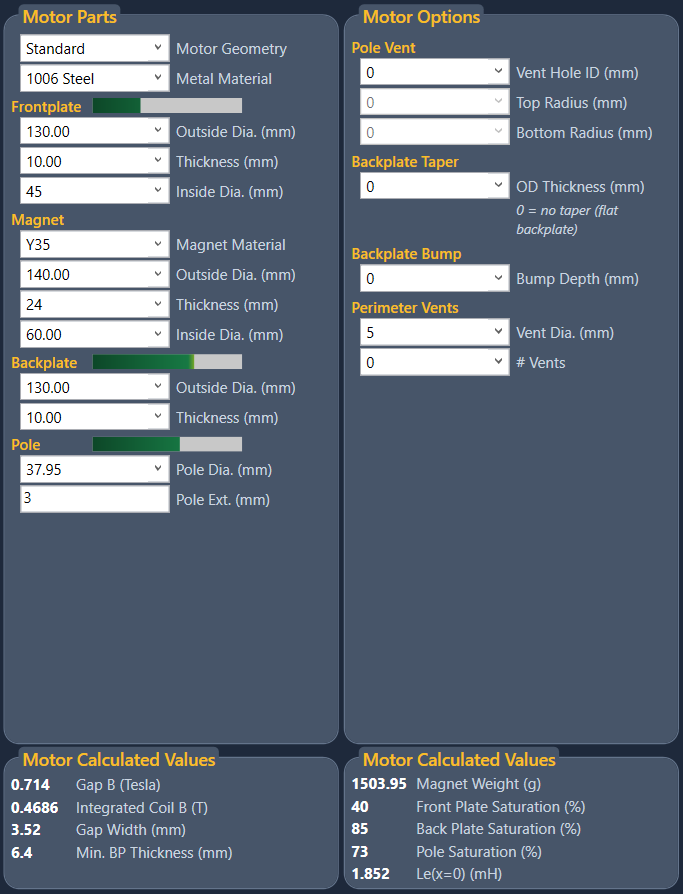
- Standard — the classic ferrite pancake: a ring magnet between a flat frontplate and a backplate, with the pole rising through the magnet bore.
- TPole — a pancake whose pole is turned as a T, with a reduced shaft below a full-diameter head.
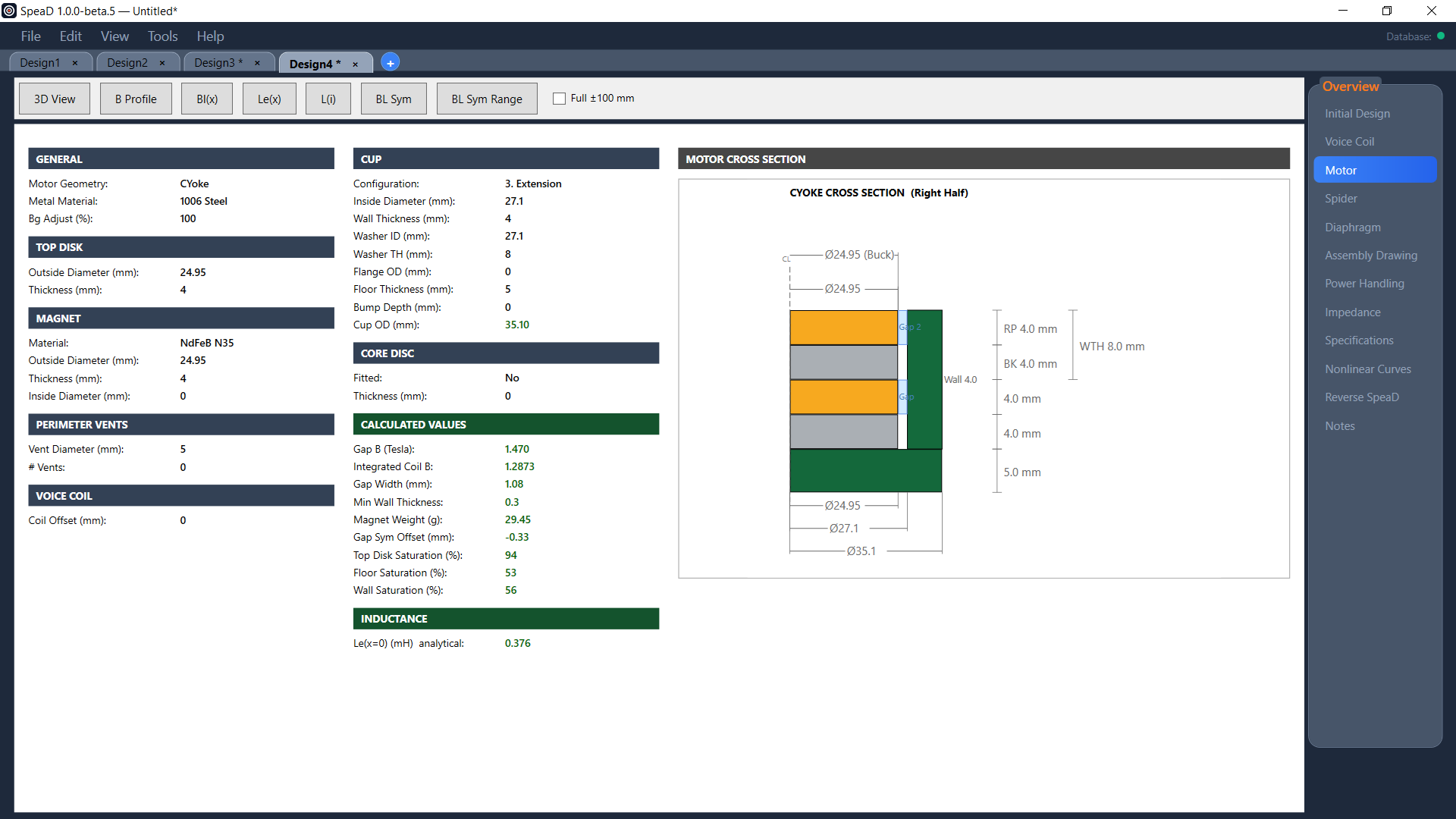
- CYoke — a cup motor with the magnet inside, the usual layout for neodymium, with its own cup features, core disc, bucking magnet and return plate.
Motor Options add the parts a motor may or may not have: a pole or center vent with top and bottom edge radii, a tapered or bumped backplate, and perimeter vents. Saturation for every steel part shows as a coloured bar while you type, so you can see where flux is limited and where steel is sitting idle.
Bucking magnets and LRRP
On a CYoke, a second magnet on the top disk, polarised against the main magnet, pushes more flux into the gap without growing the motor’s diameter. Add a return plate and extend the cup wall, and the bucking magnet gets its own low-reluctance return path — the Low Reluctance Return Path (LRRP) motor. The calculation includes the bucking magnet in Gap B, BL, Bl(x), saturation, the inductance figures and magnet weight, warns when the bucking magnet is driven past its coercivity, and draws the opposed second gap that acts as a magnetic brake near the top of travel.
Material database with real B-H curves
Both material lists are served from SpeaD’s B-H library — real measured magnetisation curves, not single-number approximations. Fourteen steels, from 1006 to 1020 low-carbon steel through cobalt-iron, electrical iron, silicon core iron and three stainless grades, each with a Black finish variant for the thermal model. Thirty-five magnet grades — the Y and C ferrite series, Ceramic 6 and 8H, and neodymium — with further neodymium, samarium-cobalt and alnico grades in the library and managed in the Data Manager.
The Motor tab and its curve windows
The Motor tab shows the full calculated read-out beside a scale cross-section of the motor as dimensioned, including vents, radii, taper, bucking magnet and return plate. Its toolbar opens live curve windows that redraw as you edit:
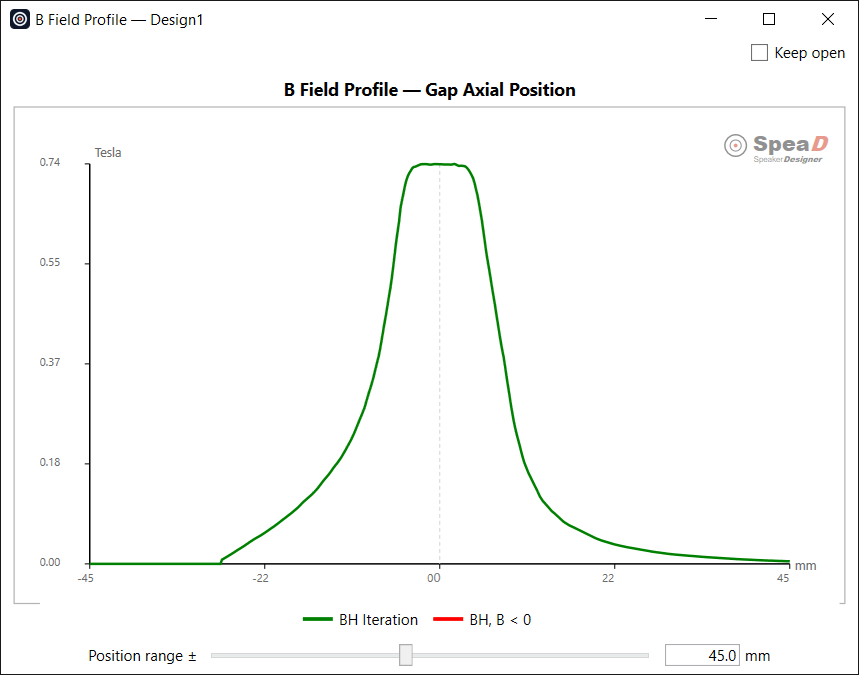
- B Profile — flux density along the gap axis, the shape that decides how BL falls off with excursion.
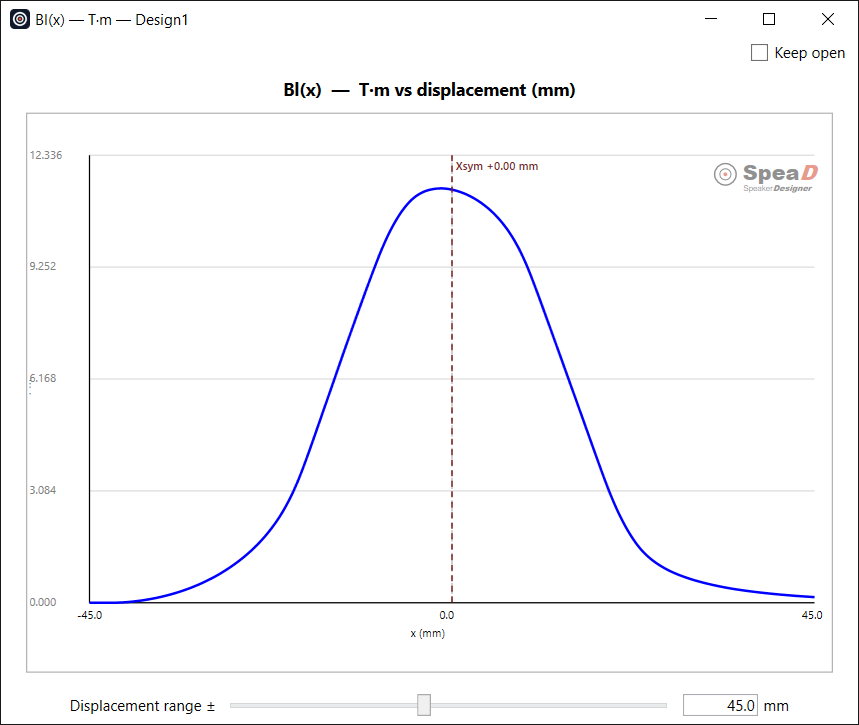
- Bl(x) — force factor against coil displacement, with the symmetry point marked.
- BL Sym and BL Symmetry Range — Bl(x) against its mirror, and the symmetry point against amplitude.
- Le(x) — voice-coil inductance against displacement.
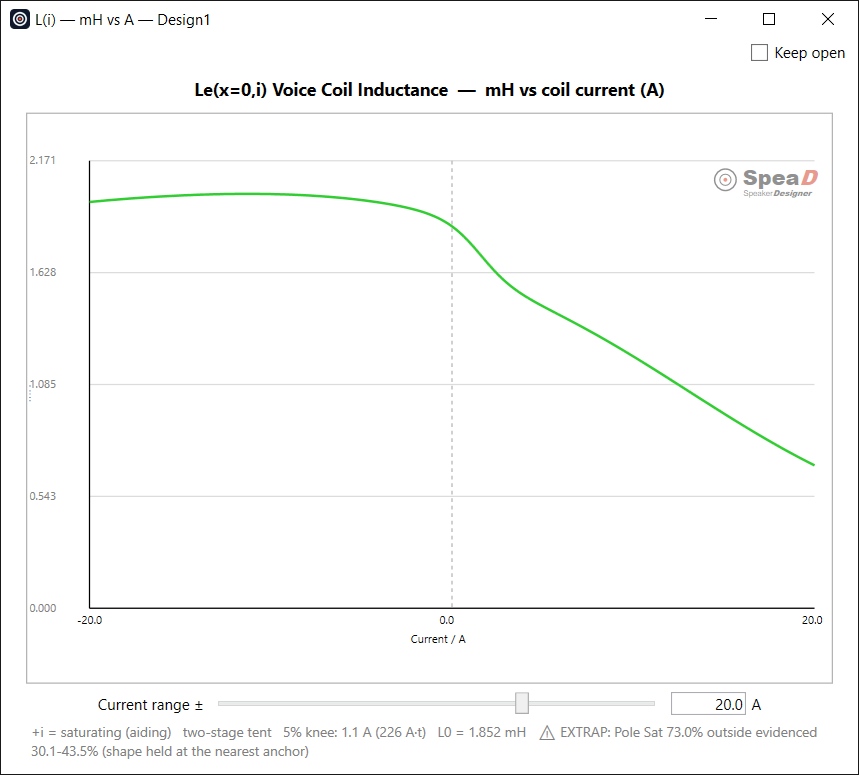
- L(i) — inductance against coil current, in the format Klippel measurements report, so measured and predicted curves compare directly.
The Parameters column reports the Klippel excursion limits Xmax10 (82 % BL) and Xmax20 (70 % BL), along with Xmax physical, Xcrash and Gap Sym Offset.
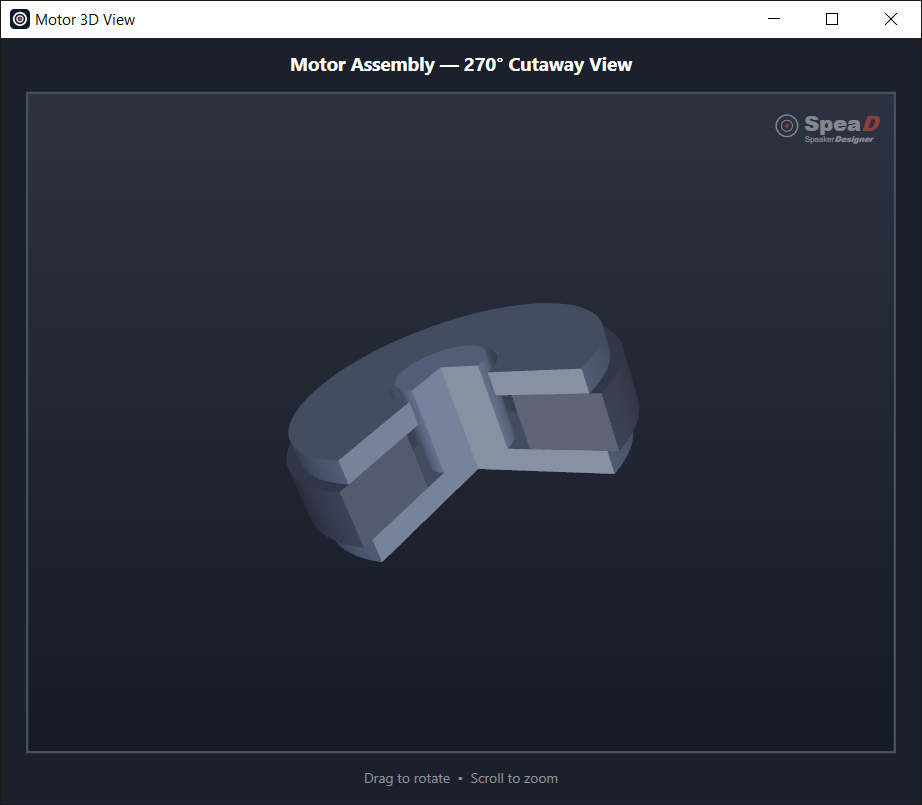
270-degree cutaway 3D model
The 3D View renders a 270-degree cutaway of the motor as dimensioned — drag to rotate, scroll to zoom. It draws the vents and their radii, the backplate taper and, on a CYoke, the bucking magnet and return plate, making it immediately clear how the magnetic circuit is constructed.
Read the Motor Parts chapter of the SpeaD Owner’s Manual for every control on the page.