SpeaD 1.0 · Power Handling
Power Handling
Heat, Compression & Ratings
How hot the driver gets under a test signal, what the heat costs, and the highest level it survives under the published power tests.
A thermal model of the whole driver
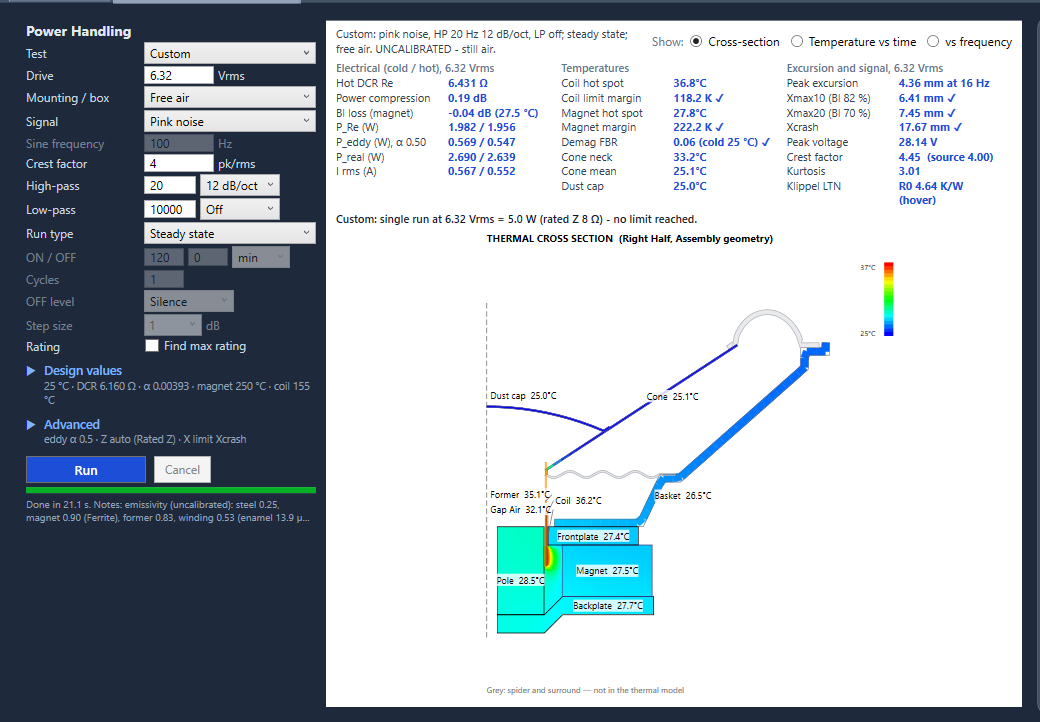
The Power Handling page runs a 2-D axisymmetric thermal model of the whole motor, voice coil, former, cone, dust cap and basket, in the true geometry the Assembly Drawing shows, driven by the real electrical heat your signal puts into the coil and the pole tips. Every run answers four questions:
- How hot does it get? Coil hot spot and mean, magnet, front plate, pole, back plate, former, gap air, cone and basket.
- What does the heat cost? Hot voice-coil resistance, power compression and the loss of force factor as the magnet warms.
- How far does the cone move? Peak excursion against Xmax10, Xmax20 and Xcrash.
- Is the magnet safe? A demagnetisation check against the magnet grade’s coercivity, cold and hot.
Standard and proposed tests
Choose Custom for full control, or one of nine standard and proposed tests, each applying its own signal, crest factor, filters and timing:
- IEC 60268-5 rated noise, short-term and long-term
- IEC 60268-21 accelerated life
- CTA-426-B accelerated life and CTA-426-B compression
- AES2-2012
- Klippel stepped +1 dB
- Keele short-term peak (proposed AES test)

Signals, mounting and run types
Pink, white and IEC 60268-1 programme noise, CTA-426-B life noise, sine, multitone, or your own WAV or MP3 file, with Butterworth high- and low-pass filters and crest-factor clipping. The driver can run in free air, a sealed box (by volume or Qtc), a vented alignment (B3, C4, BB4, SBB4) or your own vented box. Run straight to steady state, step through time with ON / OFF cycles, or raise the level step by step until the first limit.
Find max rating
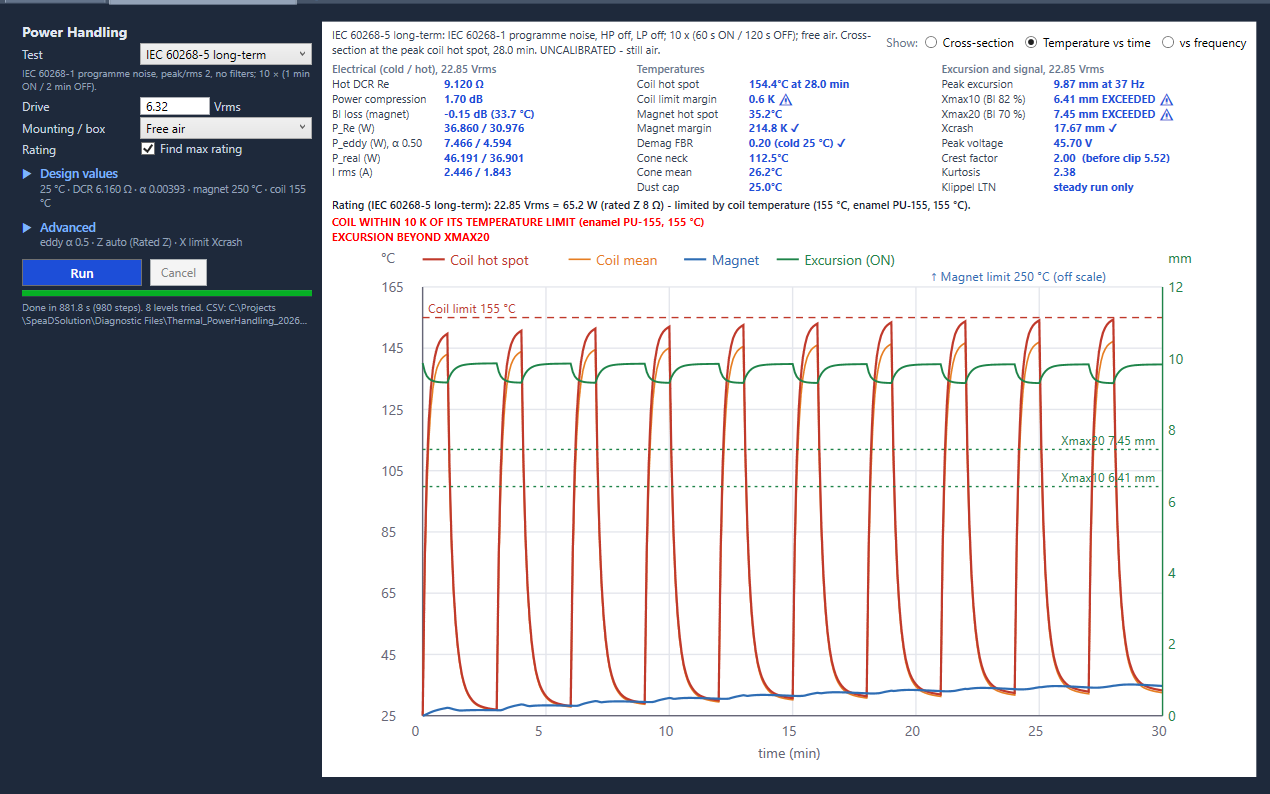
Tick Find max rating and SpeaD searches for the highest drive at which the whole test runs without reaching a limit — coil temperature, magnet temperature, demagnetisation or excursion — and names the limit that stops it. The rating is given on your choice of power basis: rated impedance, Re, Zmin or real power.
Klippel thermal parameters
A steady run also fits Klippel’s two-node thermal model and reports the voice-coil and magnet thermal resistances, capacities and time constants — the numbers to compare with a Klippel LSI or PWT measurement.
Results on other pages
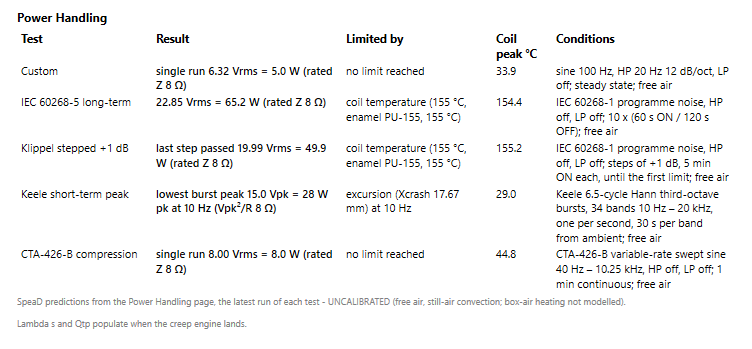
The latest run of each test is saved with the design. Specifications lists them in a Power Handling table, and Impedance draws an at-power curve beside each cold curve.
Read the Power Handling chapter of the SpeaD Owner’s Manual for every control on the page.